Performance on the INRIA Person Dataset
HOGpp implementation was validated by applying it to the task of pedestrian detection. For the most part, the experiments by Dalal & Triggs were replicated with few alterations.
More specifically, we trained a linear support vector machine (SVM) in the primal using stochastic gradient descent (SGD) on features extracted from cropped annotations of the INRIA person dataset. We then quantitatively compared the performance of the obtained classifier against models trained on descriptors extracted using OpenCV and scikit-image.
The following figure provides an intuition of the steps involved in training a pedestrian classifier and its use on HOG features for predicting the corresponding class.
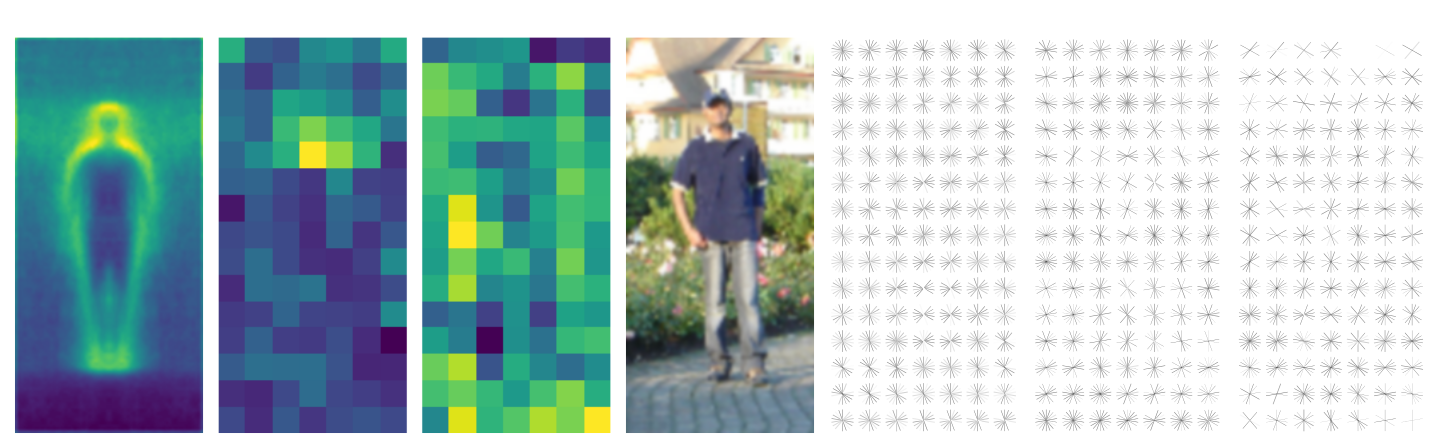
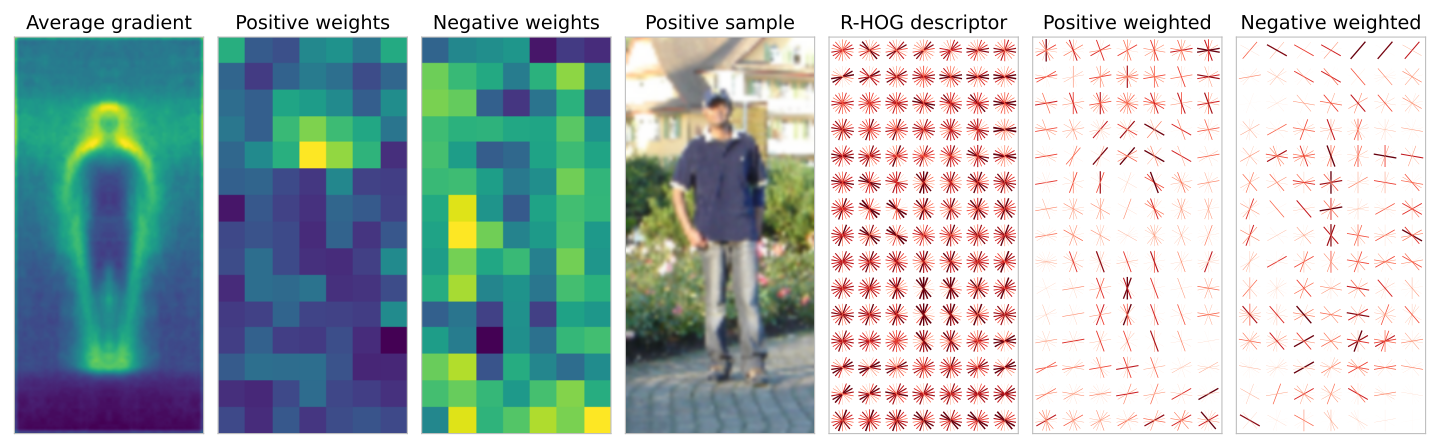
On a high level, HOG features describe the silhouette of a pedestrian which is eventually used in a way that is similar to how template matching works albeit accounting for some pose variations.
Training
For comparison purposes, we trained all the classifiers using same fixed set of HOG parameters producing a 3780-dimensional feature vector. Specifically, the parameters employed were:
9 orientation bins constructed from
unsignedgradientscell size of 8×8 pixels
overlapping blocks consisting of 16×16 pixels (or equivalently, 2×2 cells)
l2-hysblock normalization clipped at 0.2
We then trained an initial SVM classifier using 5-fold stratified inner cross-validation while optimizing the regularization term penalty using grid search. 20% of the samples of each training split were additionally used as a validation split to allow for early stopping.
After obtaining the initial model, we used each classifier to perform an exhaustive search for false positives (i.e., hard mining) and retrained the classifiers by including the hard mined samples.
We used confidence based sampling opposed to random sampling to subsample the large set of false positives. Specifically, up to 30 most confident false positives (i.e., samples farthest away from the decision boundary) were selected as hard negatives.
Quantitative Results
The following plot summarizes the performance of refined models at various thresholds.
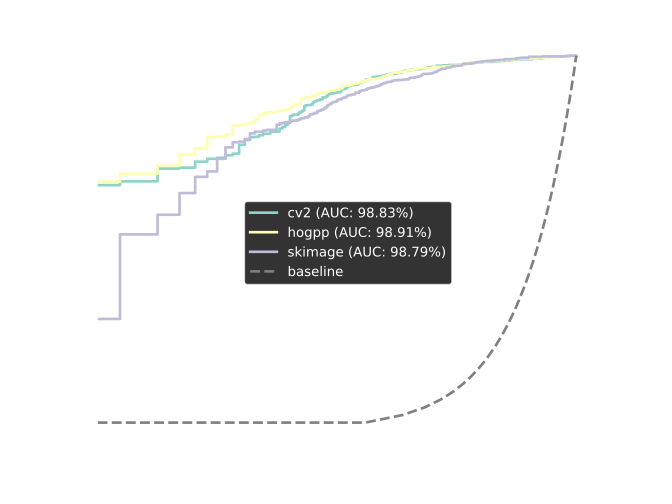
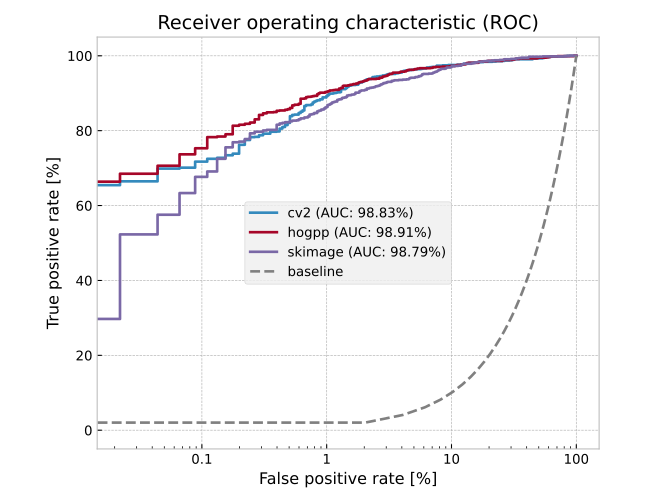
Overall, the HOGpp based model outperforms models that use OpenCV and scikit-image HOG descriptors.
A detailed look at additional classification metrics, however, shows that HOGpp achieves a lower precision compared to other two implementations. Yet, the recall and consequently the F₁ score are considerably higher thereby outperforming both implementations.
Implementation |
Precision |
Recall |
F₁ score |
Accuracy |
|---|---|---|---|---|
hogpp |
95.45% |
90.75% |
93.04% |
97.20% |
skimage |
96.95% |
83.53% |
89.74% |
96.06% |
cv2 |
98.32% |
79.46% |
87.89% |
95.48% |
Hard Negatives
It is also important to consider the number of hard negatives produced by each of the HOG descriptor implementations. The following table provides an overview of the corresponding absolute numbers.
Implementation |
Hard negatives |
|---|---|
hogpp |
30584 |
cv2 |
31113 |
skimage |
33433 |
In this specific application, the initial model obtained from HOGpp descriptors generates the least number of false positives usable for further refinement. While the overall number of training samples is lowest, the HOGpp model still achieves the best performance in terms of the F₁ score and ROC AUC. At the same time, this indicates that the initial HOGpp model already generalizes better than OpenCV and scikit-image based models.
Due to the probabilistic nature of the learning process, particularly the number of hard negatives can vary depending on the chosen seed. Therefore, the corresponding numbers should be taken with a grain of salt because at times the OpenCV based model can produce fewer hard negatives than HOGpp. This observation, however, does not affect the generalization ability of the refined models on this task.
Runtime Performance
The following bar plot summarizes the average runtime of individual HOG implementations for extracting the descriptor of a single 128×64 (height×width) region of interest (ROI) within a larger image as performed during hard mining.
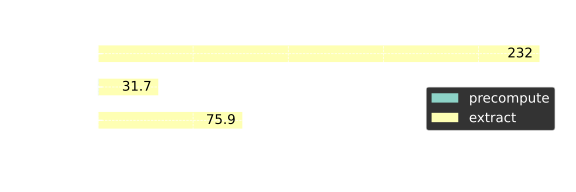
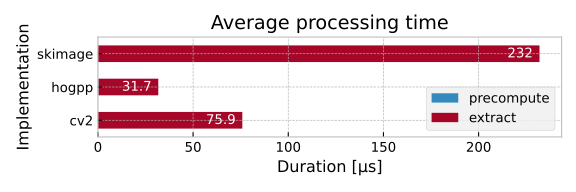
The runtime of the precompute stage applicable only to HOGpp is negligible
and can therefore be hardly observed in the bar plot. As such, the extract
stage is computationally more expensive. Nevertheless, HOGpp outperforms both
implementations in terms of the average cumulative runtime for a single ROI
consuming around 32 μs.
The speed up factor achieved by HOGpp with respect to OpenCV and scikit-image implementations is as follows:
cv2 |
skimage |
|
|---|---|---|
hogpp |
×2.4 |
×7.3 |
Final Remarks
As always, the provided results are specific to the described experiment, environment, and the setup used to evaluate the models, and therefore should not be extrapolated to different tasks without validation.